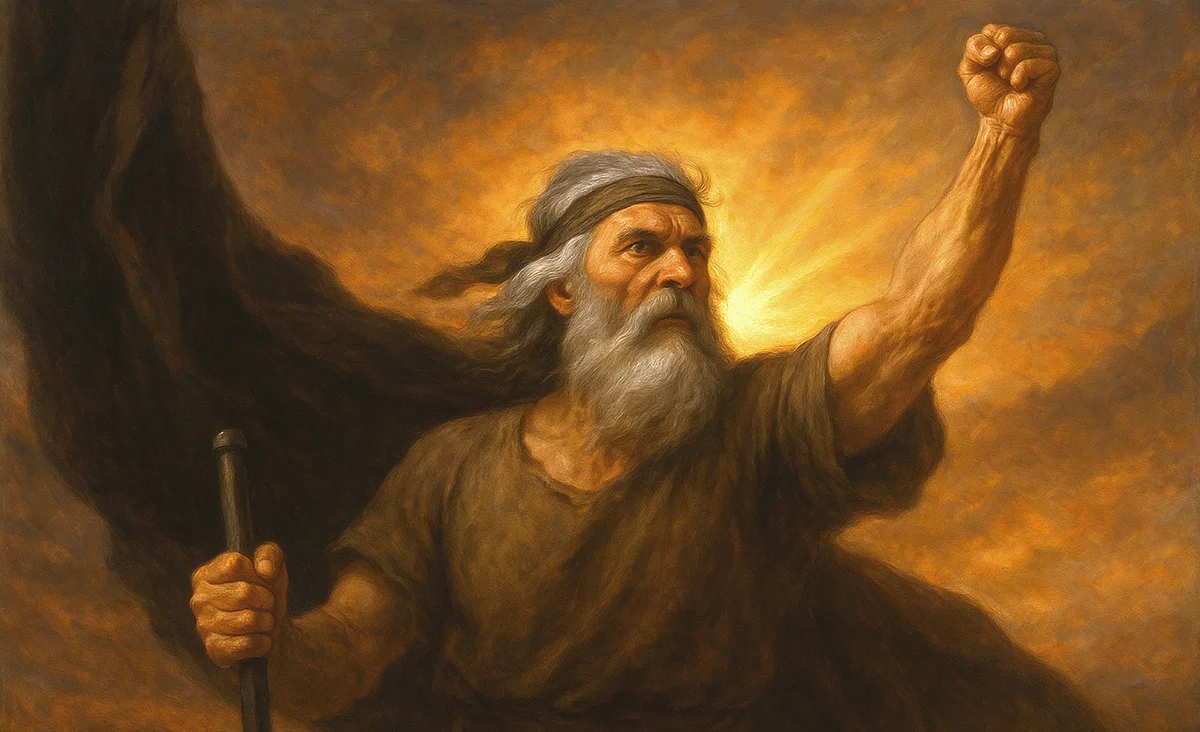
After Kaveh’s sons were killed by Zahhāk, the blacksmith courageously rose against the tyrant. Leaving Zahhāk’s palace, Kaveh lifted his leather apron upon a spear and proclaimed: “Whoever desires the death of this demonic and oppressive Aži-Dahāka, and seeks the kingship of Fereydun, join me!”
The story of Kaveh’s uprising in the Shahnameh illustrates the decisive role of the common people in revolting against a cruel ruler. Popular symbolism is especially prominent in this narrative, where the people receive direct emphasis.
The story begins with Jamshid, whose divine glory (farr-e izadī) departed from him (Avesta, Dustkhah edition, 2008: p. 490; Shahnameh, Khaleghi-Motlagh). Iranian nobles searched the world for a just king to replace Jamshid and eventually turned to Zahhāk (Aži-Dahāka).
Zahhāk (Aži-Dahāka) originally possessed a noble nature, and his father had been a just ruler. But he fell under the influence of the demonic serpents that had grown from Ahriman’s kiss upon his shoulders. To soothe these serpents, Zahhāk was compelled to feed them the brains of young men.
During this period, Fereydun—the son of Ābtin and a descendant of Jamshid—was born in the land of Varena (Avesta, Dāmāvand edition, 2008: vol. 2, p. 663).
Fereydun was secretly raised by a cow named Barmāyeh, hidden from Zahhāk’s schemes to locate and kill the prophesied child. At the age of sixteen, Fereydun learned of his lineage and resolved to overthrow Zahhāk, preparing himself for the coming struggle.
Meanwhile, Kaveh the blacksmith, grieving the loss of his sons at the hands of Zahhāk, bravely confronted the tyrant and sparked a revolt.
Kaveh departed from Zahhāk’s palace, raised his leather apron as a banner, and cried out:
Whoever desires the death of this demonic and unjust Zahhāk, and seeks Fereydun’s rightful rule, join me!
Kaveh deemed no one worthy of kingship except Fereydun, for the divine glory (farr-e izadī) had passed to him (Avesta, 2008: pp. 490–491).
Fereydun joined Kaveh’s uprising and ordered the forging of a mighty mace called the cow-headed mace (gorz-e gāvsār) for striking down Aži-Dahāka.
With the help of Kaveh and the young men who had been secretly saved (1), Fereydun triumphed over Zahhāk, struck him with the mace, and bound him.
The glory departed—the glory of Jamshid… this glory was taken up by Fereydun, son of the house of Ābtin… he who overthrew Aži-Dahāka.(2) (Avesta, 2008: pp. 490–491)
Fereydun carried Zahhāk into the mountains, and just as he was about to kill him, a message from Sraosha commanded him instead to imprison Zahhāk upon Mount Damāvand. Thus Fereydun bound the tyrant for eternity within Damāvand, and thereafter became the world’s king endowed with divine glory.
The Great Mehrgān(3) is traditionally associated with Fereydun and Kaveh’s victory over Zahhāk, the captive’s imprisonment in Damāvand, the raising of the banner of Kaveh (Derafsh-e Kāveyānī), and the coronation of Fereydun (4).
Edited by Ashkan Dehqān Based on an article by Meysam Saebi in Sarzamin-e Āzādegān, Issue 6.
Notes
1- Zahhāk’s two cooks, Armayel and Garmayel, secretly saved one of every two youths that Zahhāk intended to sacrifice. These rescued youths later joined Fereydun in the mountains (Shahnameh, Khaleghi-Motlagh edition: pp. 56–57).
2- Zamyād Yasht, verses 36–37.
3- In Zoroastrian tradition, the principal Mehrgān festival was celebrated on the 16th of Mehr, while the Great Mehrgān (Mehrgān-e Bozorg) fell on the 21st of Mehr. The latter—on Rām Day—commemorated Fereydun’s victory over Zahhāk, whereas the 16th marked the older, primary autumnal festival dedicated to Mithra.
4- In the Avesta, the story of Fereydun’s battle with Aži-Dahāka appears in an earlier form (Avesta, 2008: pp. 137, 491, etc.). The royal Kavi dynasty is mentioned frequently, but Kaveh the Blacksmith does not appear explicitly; explicit references to Kaveh appear mostly in later sources.
Bibliography
Al-Biruni, Abū Rayḥān (2010). Chronology of Ancient Nations, trans. Akbar DanaSeresht, 6th edition. Tehran: Amir Kabir.
Dustkhah, Jalil (2008). Avesta: The Ancient Sacred Texts of the Iranians, 13th edition. Tehran: Morvarid.